The theme so far on this last day of #ASH is to treat or not to treat these conditions. Most have heard of the iStopMM study ongoing in Iceland. They invited adults in Iceland who were born before 1975 or earlier to participate in this study to detect the incidence of multiple myeloma in a large population. 148,704 people were offered participation, and in the first month, 50,000 Icelanders signed up. 80,759 in total signed up during the enrollment period, and 75,422 had their blood samples collected. I’m still boggled by the generosity of over half of the target population of Icelandic people willingly signed up to selflessly give of themselves to help the rest of the world. You can read all about the study at https://istopmm.com/
Conclusion: “In this study evaluating the presence of clonal plasma cells in bone marrow samples from IgA and IgG individuals by next-generation flow cytometry, we detected clonal plasma cells more frequently in samples from individuals with IgA MGUS compared to IgG. Additionally, the absence of clonal plasma cells correlated with a higher frequency of transient M protein and an absence of disease progression. These findings provide biological insight into the differences between IgA and IgG MGUS, which may contribute to the lower rate of progression in IgG MGU.”
The other very interesting program was two physicians stating their case for either early intervention in smoldering multiple myeloma (SMM) or active surveillance. Dr. Mateos spoke eloquently about why she believes treatment of high-risk smoldering multiple myeloma (HR SMM) can lead to a cure. Dr. K. Ramasamy says that there are potential downsides to early treatment, along with costs and toxicities.
The DreaMM-7 trial compared bBlenrep (belatamab mafodtin), Velcade (bortezomib), and dexamethasone [BVd] versus Darzalex (daratumumab), Velcade (bortezomib) ,and dexamethasone [DVd] in relapsed refractory multiple myeloma (RRMM). There was an N of 494 patients, randomized into the two arms. I was pleased to see a study with more than the usual N of single-digit patients. The surprising news was that the BVd arm performed better than the DVd arm. The primary reason for individuals who left the study from both groups was disease progression.
The next oral abstract in the session was a multi-site (124 sites in 23 countries) study of Darzalex (daratumumab) monotherapy vs active monitoring in patients with HR SMM, the AQUILA study. The dara arm showed significant improvement in time to disease progression.
The goal of the IMF’s Myeloma Voices at ASH team is multi-focal:
Goal #1 is to amplify the patient voice at ASH, during networking, Q/A sessions during presentations, and on our blogs and social media posts. We think it is just as important for researchers to hear from patients as it is for patients to hear from researchers.
Goal #2 is to bring the ASH experience and knowledge to the global myeloma community in real-time. We accomplish this by blogging, vlogging, and posting to various social media platforms. Allowing patients and care partners into the world of myeloma research provides hope.This year, I delved head-first into posting on X during my ASH experience. I posted slides from abstracts, impressions of presentations, and reposted other’s posts that I found interesting and engaging. One of the other Virtual Myeloma Voices at ASH Team members, Jessie Daw, posted an incredible thread about the mental impact of having MGUS or SMM. As of now, that thread has 5,341 views!
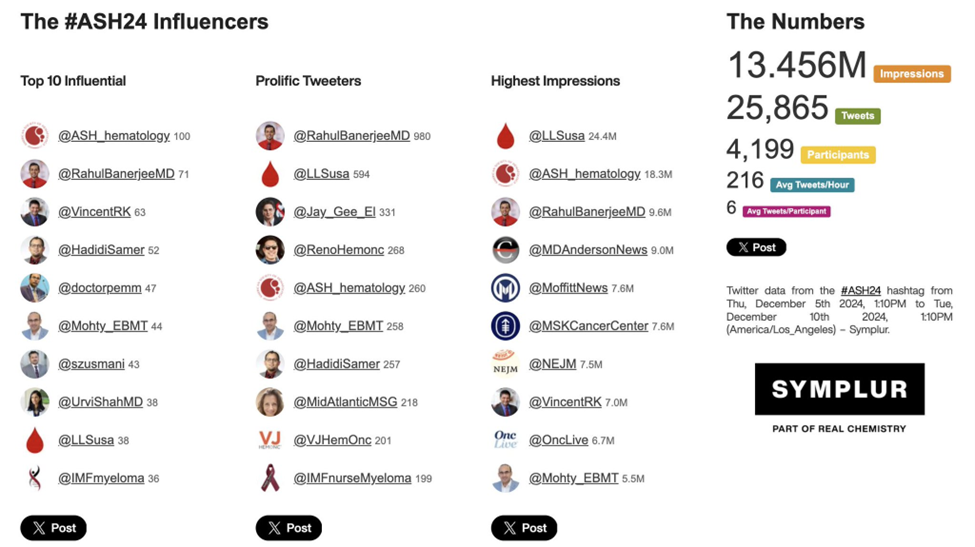
You can see below, from the data that ASH provided for the #ASH24 influence on X that there were 25, 865 tweets with the hashtag #ASH24. I also LOVE that the great majority of all handles below are myeloma-focused accounts: myeloma specialists, organizations, and nurses like Teresa Miceli (@IMFnurseMyeloma) and myself (@MidAtlanticMSG). I also love that from the in-person team accounts, many of the rooms where myeloma presentations were held were packed, into overflow, and past! So much work and interest in myeloma research—how can we not be hopeful about that!
You can read and view all of the Myeloma Voices at ASH blogs/vlogs on this website. At that same page, under our photographs, you can see all of our social media handles-follow us! You can read through all our posts, view slides, and interact with us there!
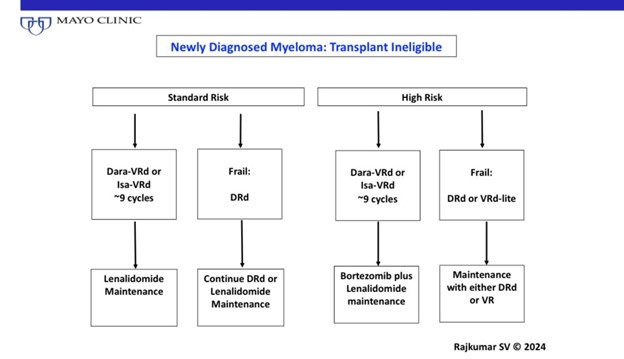
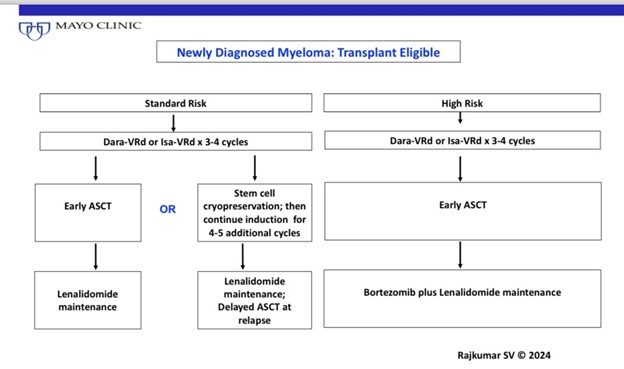
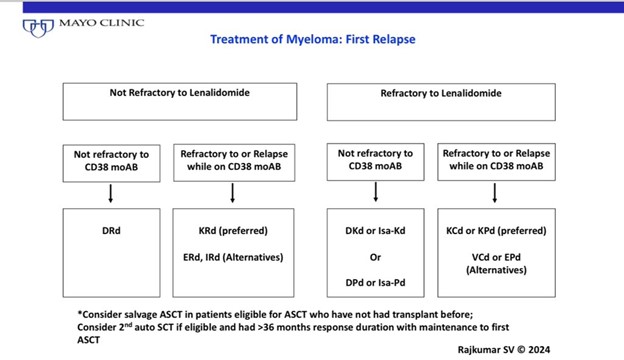
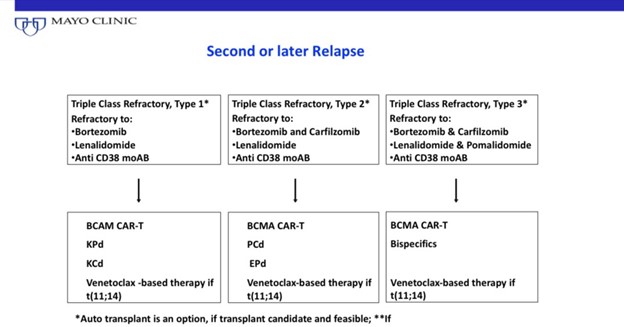
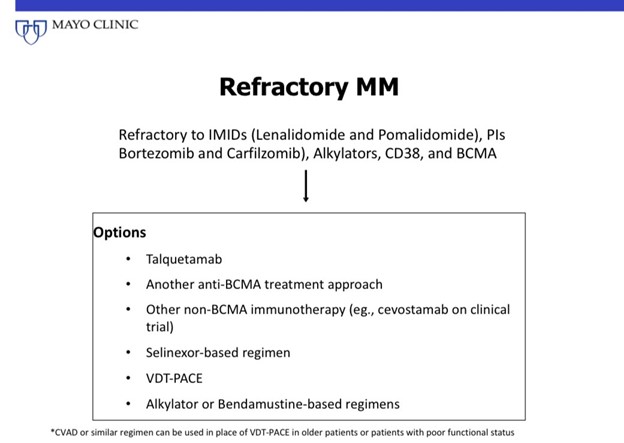
The whirlwind of #ASH24 has slowed down and now it is time to digest all the info we have seen presented. Every year, I find it very important to review IMF Chairperson of the Board Dr. S. Vincent Rajkumar’s updated myeloma treatment algorithms based on the data presented at ASH. It is exciting to see new research implemented into his guidelines yearly. Dr. Rajkumar is careful to say that these are general principles and that treatments evolve and individualized treatment is a priority. He also says that, in general, a clinical trial is preferable if one is possible and available. With a trial, so that more can be learned. So much work in myeloma research across the globe goes into what is presented here at ASH—I”m so grateful to all.
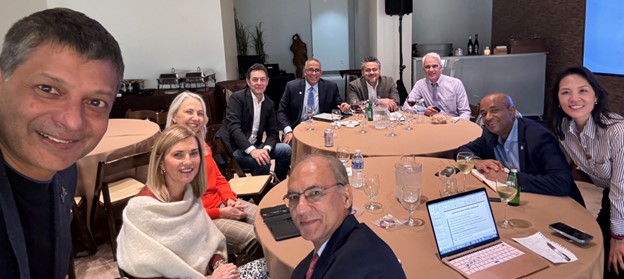
I wanted to start this blog by including a photo of the IMF’s newly formed Scientific Advisory Board (SAB). (It is this blog’s main photo.) I am so proud and excited for their input into research in the future. So much #myeloma greatness in this photograph and more importantly, kindness, integrity, and passion to better the lives of myeloma patients everywhere. Thank you, SAB!
Dr. Rajkumar’s annually updated myeloma treatment algorithms:
First relapse. Dr. Rajkumar doesn’t recommend CAR-T in first relapse, even though it’s approved,except in very selected patients (eg., high risk progressing early while on quad therapy)
Second or later relapse.
True Penta-refractory myeloma (refractory to a proteasome inhibitor, or PI; an immunomodulatory drug, or IMID; a CD38, alkylator; and BCMA-targeted approach):
The MajesTEC trials are being reported quite a bit it seems. These are studies with Tecvayli, or teclistamab (that’s the TEC). I watched/listened to about MajesTEC 5, 4, and 2. Each looked at different dosing and combos, and each study showed that teclistamab comes with neutropenia, so most all needed IVIG during their treatment.
A new drug, ABBV-383 (now named Etentamig) is being tested in relapsed or refractory (R/R) patients who have had more than three lines of therapy. They’re testing it with either Pomalyst (pomalidomide), Revlimid (lenalidomide), or Darzalex (daratumumab)—(all with dex, sorry). The Eten/dara/dex arm showed an overall response rate (ORR) of 83%.
Blenrep (belantamab mafodotin) is back in trial after being approved and then promptly recalled by the FDA. Dr. Saad Usmani reported on the DreaMM-9 trial with bela plus Velcade (bortezomib), Revlimid (lenalidomide),and dex, or VRd. The ocular concerns are part of the issues for patients who must see an ophthalmologist before each infusion.
A novel BCMAxCD3 bispecific antibody is in phase 1 trials for R/R multiple myeloma patients. I’m really not qualified to comment on this—all I could see was that 40 patients were enrolled and 35 discontinued. That seems like a pretty high attrition rate! But time will tell if there is a population who needs this. He said the five remaining on the trial are doing well on a compassionate need basis. So, they may not have any options.
There were more studies with teclistamab, including a retrospective study of real-world data comparing fit versus frail older people. Interesting that TEC showed similar outcomes.
The first two days of the 66th American Society of Hematology (ASH) Annual Meeting—Friday’s Satellite Symposium and Saturday’s research presentations—offered limited content specifically focused on smoldering myeloma (SMM). However, a few key discussions stood out, providing insights into treatment strategies, disease progression mechanisms, and the psychological impact of living with precursor conditions. These set the stage for additional abstracts on SMM during the rest of the conference.
Understanding Disease Progression: From MGUS to Myeloma
A presentation by Dr. Michaela Liedtke, MD, examined the mechanisms driving the progression of monoclonal gammopathy of undetermined significance (MGUS) to active myeloma. While the talk focused on MGUS, the findings are also relevant for SMM, which serves as an intermediate stage.
Dr. Liedtke categorized progression mechanisms into three main areas:
Clone Intrinsic Factors: These include the type and level of the M-protein, abnormal light chain ratios, and specific genetic mutations.
Clone-Host Interactions: The interplay between cancerous cells and the patient’s immune system or bone marrow microenvironment is critical in disease evolution.
Host Factors: Patient-specific factors, like age and obesity, also influence disease progression.
These insights reinforce the importance of understanding individual risk profiles in managing precursor conditions like MGUS and SMM. Questions I have as someone with SMM include how can we significantly change our immune system function and/or the bone marrow microenvironment? Also, while I cannot control my age, I do have some measure of control over my body mass and fitness.
Treatment Decisions for Smoldering Myeloma
The transition from smoldering myeloma (SMM) to active myeloma is complex, and decisions about treatment are critical. In one of Friday’s Satellite Symposiums, Dr. Shaji Kumar, MD, presented on “Newly Diagnosed Multiple Myeloma: Many Choices and More Questions,” and this content has some relevance for those with SMM. As a reminder, the standard of care for low and intermediate-risk SMM is active surveillance, while for high-risk, it is either active surveillance or possible treatment, preferably within a clinical trial.
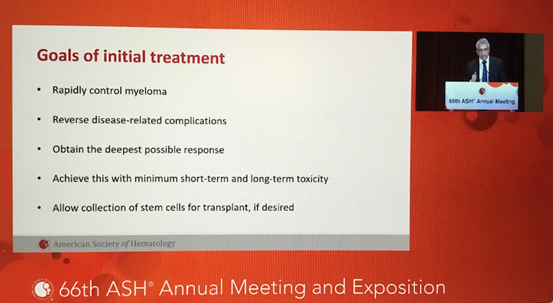
One of the key messages is that the first treatment can set the stage for long-term outcomes. Indeed, the goals of initial treatment were highlighted.
We want to use the very best treatment first, as we don’t want any subclones that remain and develop into treatment-resistant clones down the road. Dr. Kumar highlighted obtaining the deepest response possible, and I’ve heard other specialists emphasize that making the initial therapy the best possible choice can influence overall survival and quality of life. Additionally, care must be tailored to each individual. Factors like genetic markers, disease aggressiveness, and a patient’s overall health (including frailty) play crucial roles in developing a treatment plan. Frailty in particular was highlighted as a major determinant of survival and should inform both treatment intensity and supportive care measures.
For those with SMM, this information is crucial, especially when deciding between active surveillance/watchful waiting, starting treatment, or participating in clinical trials. For me personally, I’ve decided to wait as long as possible to start treatment (I have three high-risk cytogenetic features), using the time instead to get in the best shape possible while eating the best foods possible.
The Psychological Toll of Precursor Conditions
Living with a precursor condition such as MGUS or SMM is not just a physical challenge—it’s a mental one, too. Interestingly, while some specialists have noted that their SMM patients experience higher levels of anxiety than those with active myeloma, studies on this topic have produced conflicting results.
At last year’s ASH, the iSTOPMM study reported minimal psychological impact associated with being diagnosed with a precursor condition. However, a UK-based study by Dr. Sandra Quinn, PhD, and colleagues presented at this year’s ASH found the opposite. Using both quantitative surveys and qualitative analysis, the study revealed that both MGUS and SMM patients experience reduced health-related quality of life (HRQoL) compared to the general population. Key findings included:
MGUS patients reported worse outcomes than SMM patients in areas like anxiety, depression, fatigue, and sleep disruption.
Qualitative data highlighted themes such as:
Living with the Unknown: The uncertainty of disease progression weighs heavily on patients.
Prevention as Cure: Many patients feel they are constantly searching for ways to prevent disease progression.
Remediation Through Treatment: Treatment is often seen as the only way to restore normalcy.
Needless Suffering: Some patients feel trapped by the lack of clear guidelines for managing precursor conditions.
This underscores the need for psychosocial support alongside clinical care to help patients navigate the emotional challenges of living with these conditions. Personally, I experienced significant anxiety in the first few years after my diagnosis. I’m more accepting of this now, and in a way, I look at this diagnosis as a gift as I’ve been given the opportunity to re-evaluate my life and how I’m living it. I think I needed some critical incident to make this happen, and I appreciate the changes I’ve made.
Final Thoughts
While the first two days of ASH 2024 offered limited SMM-specific content, these highlights provide valuable perspectives for patients and providers alike. The conference schedule suggests that Sunday, and especially Monday, will feature more in-depth discussions on smoldering myeloma. Stay tuned for additional updates as the conversation around SMM continues to evolve.
After yesterday’s abstract sessions, I think I have more questions than answers. Not exactly what I was hoping for, but questions do lead to more investigation and knowledge. There was a lot of discussion about the use of TECVAYLI (teclistamab). This bi-specific antibody is currently used only in later lines of therapy, but trials are now looking at it as part of induction and maintenance therapy.
This constant review of combinations may lead to even deeper initial responses, which is certainly the goal, so it’s certainly worth exploring. But the current induction standard of care quadruplet of Darzalex (daratumumab), Revlimid (lenalidomide), Velcade (bortezomib), and dexamethasone seems so effective for most patients that I continue to question whether you would not save bi-specifics for later use in your myeloma treatment arsenal.
Treatment sequencing is an ever-perplexing issue – somewhat of a blessing and a curse. A blessing because that means we have many more options to select from and a curse because it is ever more difficult to select the correct sequence as well as to understand how sequencing can be tailored to each patient’s situation.
Some of today’s abstracts will provide some insight into real-world data on how bi-specifics and CAR T-cell therapy are performing, which I am looking forward to.
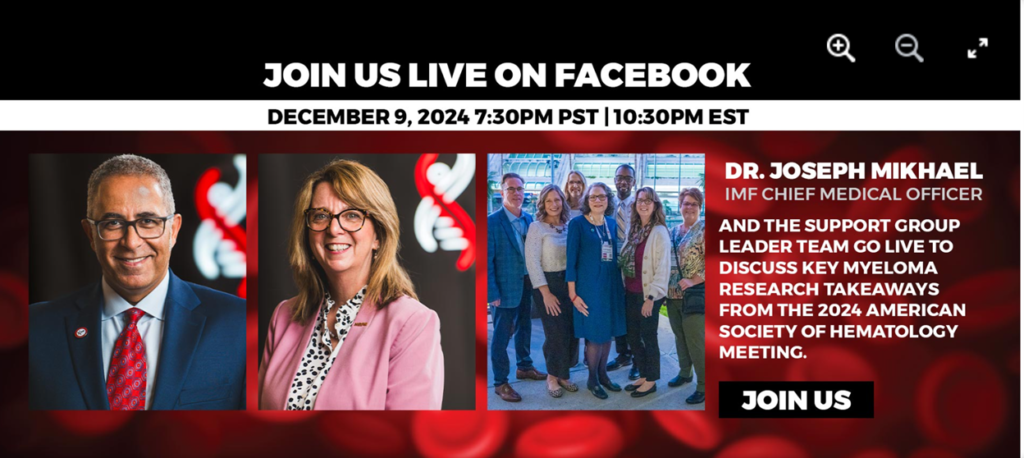
I am also very excited about the Facebook live session this evening featuring Dr. Joseph R. Mikhael (“Dr. Joe”) and his thoughts on the conference highlights and he will be taking questions as well. It may be late for my group on Eastern time, but it will be worth it!