
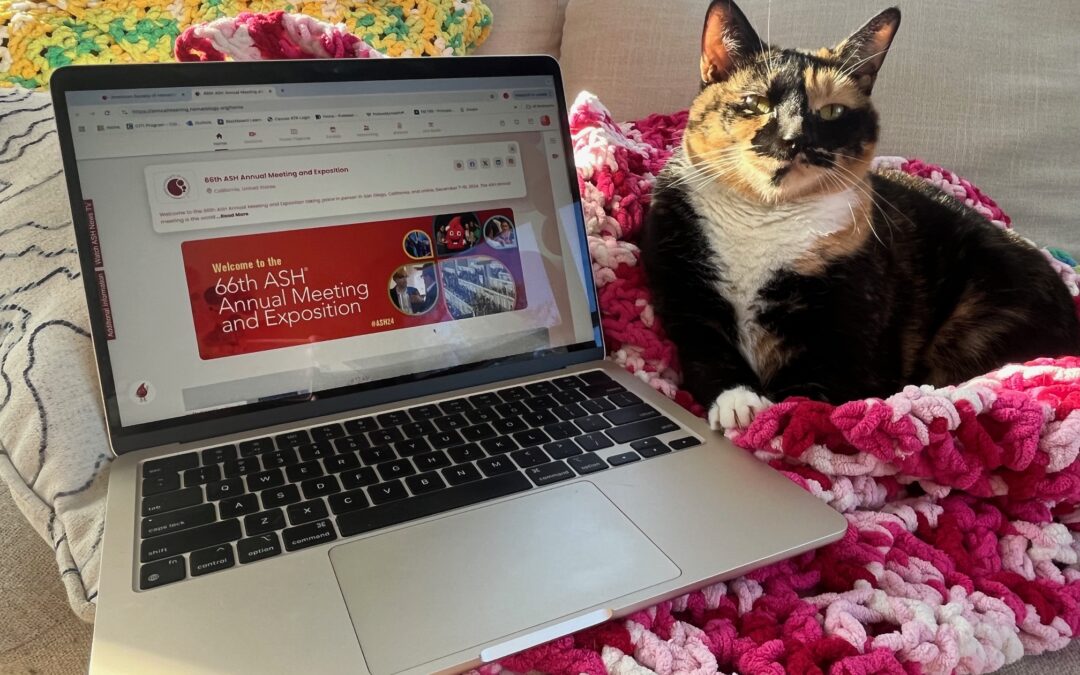
This is my fourth year attending the American Society of Hematology (ASH) meeting virtually. While I miss seeing my myeloma support group leader faMMily in person, there are some nice perks to attending ASH virtually. First, I can easily pop between sessions without having to race through the conference halls. This is a big plus because I always have trouble choosing between myeloma sessions focused on scientific innovations, clinical trials, or health outcomes and health equity. I can spend my breaks viewing talks that I miss rather than hurrying to the next location. A second related perk is that I can sit in my comfy chair. As a myeloma patient with bone involvement, I still have considerable bone pain at times, even though I’m in remission, and those conference chairs are not nearly as comfortable as sitting in a recliner with a heating pad against my back. Probably the best part of attending ASH virtually each year though is having Miss Lilypad on my lap.
We adopted Lili and her siblings Leo and Ellie a year after my autologous stem cell transplant at the prompting of my youngest daughter Ellie. Indeed, that’s how we ended up adopting 3 kittens; we almost left Ellie the Cat behind, not knowing that we had chosen to adopt her two siblings. Ellie the cat is now affectionately called Grumps and Leo is called Lenny or Nerd, and Lili has become Miss Lilypad. The nicknames suit them all so well. There is nothing that Miss Lilypad loves more than plopping down on a lap for some cuddles whenever a lap is available. That’s why she loves ASH so much, 8-12 hours of constant lap time – what can be better!
It’s a little bit challenging for me to navigate my laptop and take notes with Miss Lilypad on my lap, but she’s the boss, so I’m figuring it out. Turns out that Miss Lilypad is also quite creative and enjoys helping me write haikus about the ASH experience. One of her #ASHaiku X posts even made it into the Saturday evening ASH News Daily!
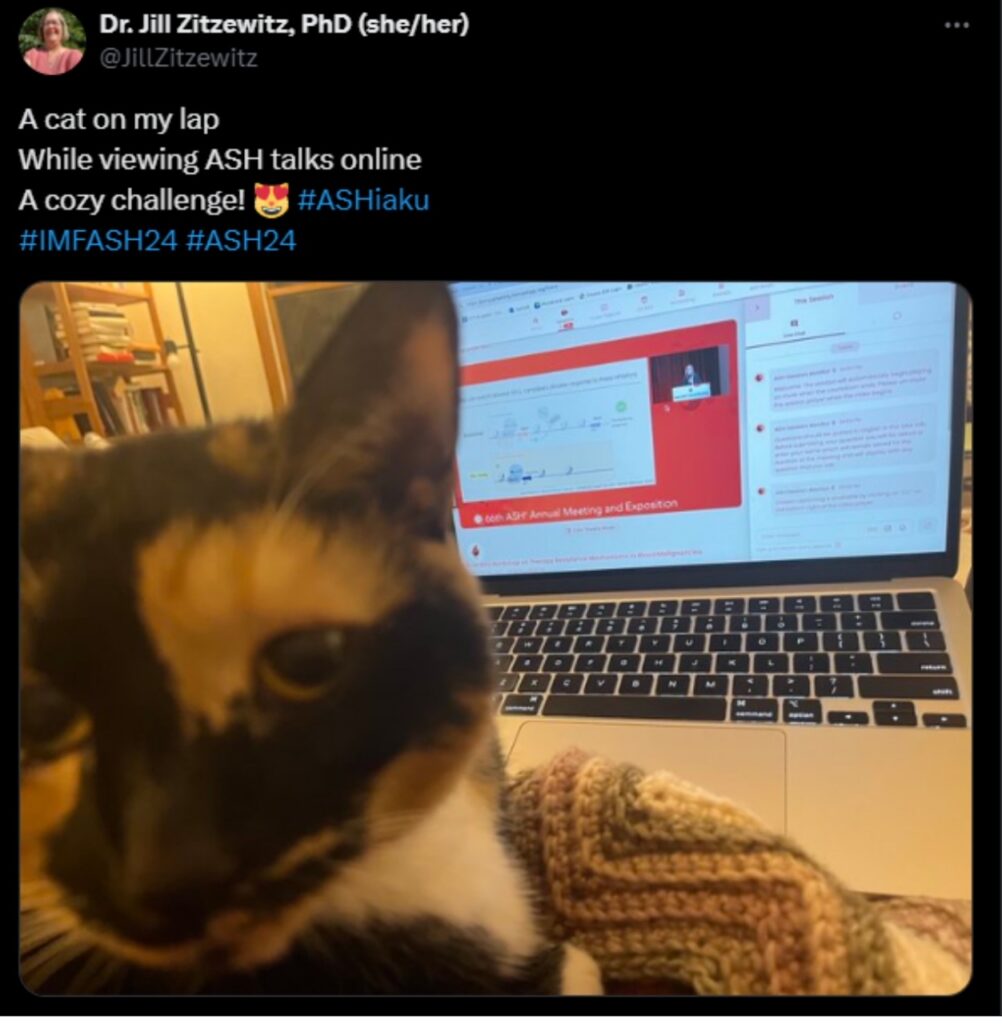
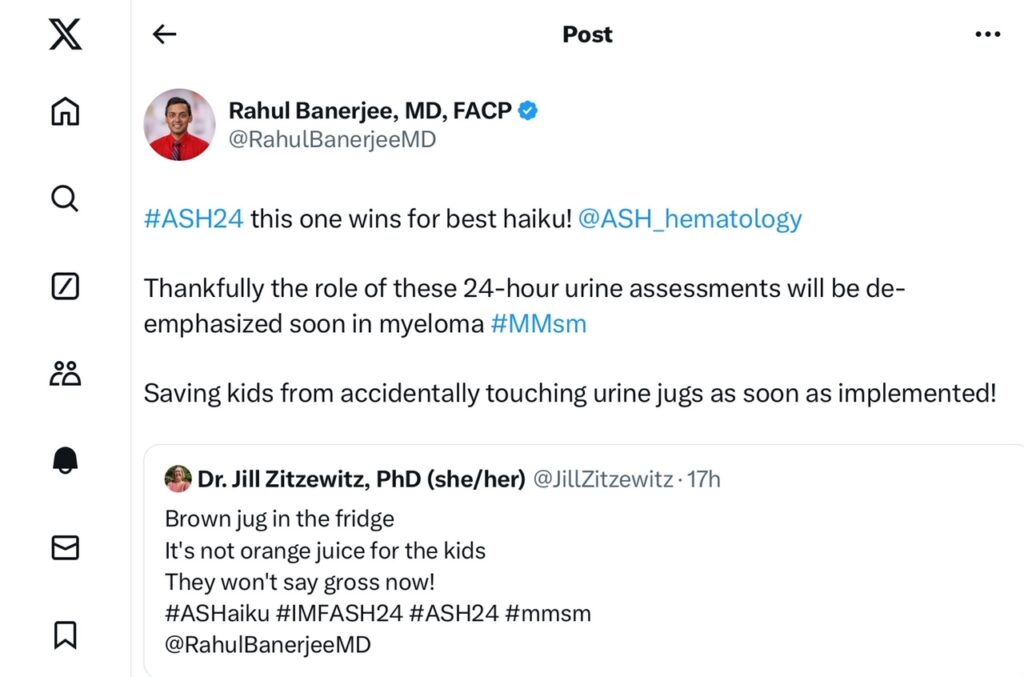
The first session that Miss Lilypad and I attended together on Saturday was a session entitled, “Multiple Myeloma: Clinical and Epidemiological: Decluttering Responses and Dynamic Risk: How Can We Improve Prognostication in Multiple Myeloma?” The entire session was excellent, but two talks particularly caught our attention. First, Dr. Joshua Gustine, MD from Massachusetts General Hospital in Boston, MA discussed how previous autologous stem cell transplant (ASCT) can affect length of progression-free survival (PFS) after CAR T-cell therapy. The results presented showed that Ide-cel, but not Cilta-cel or Anito-cel, exhibited a decreased PFS in patients who had a previous ASCT compared to those who did not. While the reasons for these differences are not yet clear, it’s another important consideration for patients to discuss with their doctor when deciding on next treatments. Miss Lilypad just hopes the CAR T-cell therapy is still off in the future for me because she thinks I have the best lap in the family as I’m the most likely to stay seated for long periods of time. The other talk in this session that caught our attention was a talk by Dr. Rahul Banerjee, MD, FACP, from the University of Fred Hutchinson Cancer Center in Seattle, WA. Dr. Banerjee made a case for eliminating the twenty-four-hour urine collection as a method for following myeloma status in clinical trials as it is a barrier for patients. While twenty-four-hour urine collection remains important at diagnosis and under some unique patient circumstances, such as concurrent amyloidosis or when there is no other clear biomarker of disease status, most patients are celebrating the results of this study because the twenty-four-hour urine collection can be quite a pain. Miss Lilypad and I were inspired to write another ASH haiku about this talk as we reflected on the years with pee jugs in the fridge when the kids were in high school, and Dr. Banerjee even gave it a shout out on X.
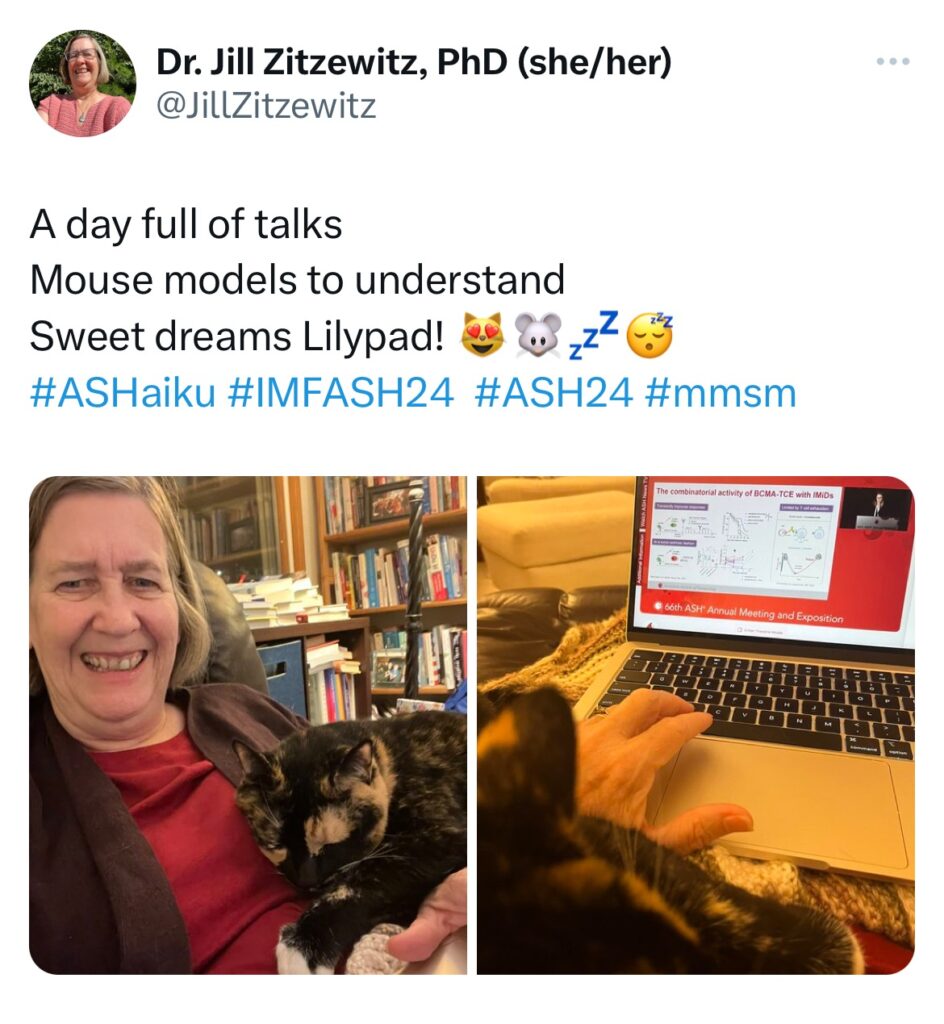
Miss Lilypad and I also attended an afternoon (evening on the east coast) scientific session entitled, “Multiple Myeloma and Plasma Cell Dyscrasias: Basic and Translational: Understanding and Improving TCE and CAR-T Cell Therapies for Plasma Cell Disorders.” This session covered lots of cool scientific talks that addressed how to improve outcomes for immunotherapies like CarT cell therapies and bispecific antibodies. As a scientist and patient, I love these talks, and I find it encouraging that so many amazing researchers are working hard to understand the challenges of resistance and loss of PFS with current immunotherapies due to issues such as the role of the tumor microenvironment in T cell activation and exhaustion. Miss Lilypad likes these talks because many of these studies are done using mouse models. She fell asleep on my lap during the session, dreaming of mice, so I’ll save reporting on the science of these talks for my next blog since there are more exciting science talks in the days ahead. Good night Lilypad!
Jill Zitzewitz, PhD, Central MA Multiple Myeloma Support Group
Follow me (and Miss Lilypad) on X @JillZitzewitz
Jill, I love your humor interspersed with your blogs. The brown jug in the frig not being juice for the kids brings back so many memories! Not only did I, of course, have that jug at home in the frig, but also took it to work with me and kept it in our cold room in a back cabinet with a note on it. Since many labs used this cold room, I figured I better have a warning label on it! :-)!